
Nineteen Ways of Looking at a Cone
June 2, 2026. A journey through the realms of art, literature, philosophy, math, physics, engineering and beyond, all through the lens of a humble cone of swarf.
I. Prelude
In his book How to Teach Mathematics, Steven G. Krantz cites the (probably apocryphal) question above as an example of “minimalist” exam design. It may be short, but to my mind, this is the opposite of minimalist. In its radical openness to interpretation, to freedom of response, it begs for creative exegesis in a way that standard exam questions—with their model answers, closed rubrics, and rote curricular adherence—do not. So, in the spirit of Wallace Stevens’ “Thirteen Ways of Looking at a Blackbird”, Philip Ording’s 99 Variations on a Proof, Queneau’s Exercises in Style, and Nineteen Ways of Looking at Wang Wei by Eliot Weinberger, I propose a variation on one of my favourite themes: variations on a theme. With that self-reflexive flourish, let us begin.
Contents
I. Prelude
II. Overture
III. Reading
IV. Portrait
V. Treatise
VI. Poem
VII. Story
VIII. Translation
IX. Plans
X. Dialogue
XI. Institution
XII. Exam
XIII. Proof
XIV. Exercise
XV. Fugue
XVI. Performance
XVII. Koan
XVIII. Way
XIX. Coda
II. Overture
A cone is a naturally poetic form: it radiates outward from a point, conveying by means of space what a stone dropped in a pond does through time; it is a spatial ripple. We will let this ripple carry us radially away from the object of our meditations and into the diverse realms of art, literature, poetry, philosophy, math, physics, architecture, engineering, and beyond. We should be careful not to dismiss the other features of the problem; the cone is made up of metal shavings, otherwise known as swarf. We will mass a number of cursive fragments to constitute our discourse, fragments which are, so to speak, shored against our ruin. Finally, these shavings are warm. Statistically speaking, warmth is another name for molecular randomness, a variance in the behaviour of the constituent parts. Here, the parts will deviate from one another, but that deviation shall itself be lawlike. We contort the analogy no further.
III. Reading
Querent. What is the significance of these fragments?
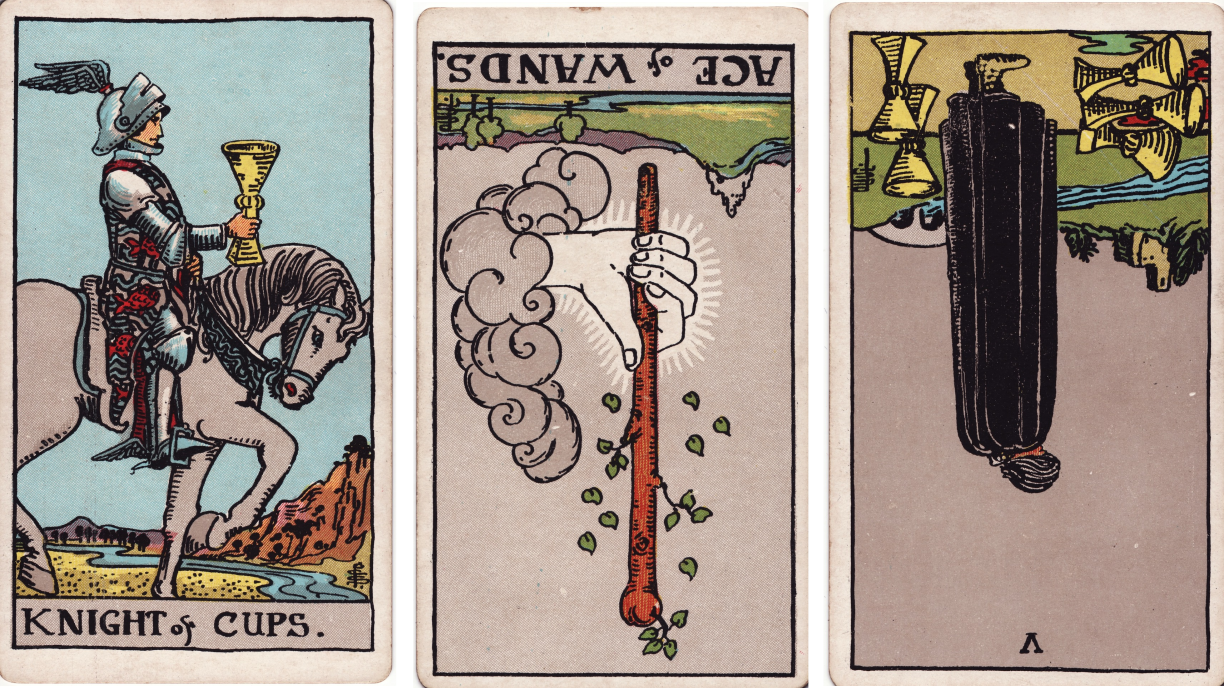
Knight of Cups, Ace of Wands (reversed), Five of Cups (reversed).
Mind (Knight of Cups). The Knight of Cups holds aloft an inverted cone, almost like an offering, and proceeds with calm self-assurance through a parched landscape. A river flows in the background, a reminder of new life perhaps flowing from the cup, while the wings attached to the knight’s helm connote speed or the possibility of flight. Together, these symbols represent the life-giving power of creative imagination, while the unblemished steed stands for purity of intent. In this context, the card suggests that, by virtue of creative force innocently exercised, the collection will confer life on an otherwise lifeless subject. This will be of a predominantly intellectual character, if we are to take the association with “mind” seriously.
Body (Ace of Wands, reversed). The Ace of Wands is a powerful symbol of inspiration, growth (note the leaves), and potential, reinforced by the linear image of the wand and the mysterious apparition of the hand holding it. In the distance, a mountain peak suggests future hardship which the initial impetus may carry us toward and through. Reversed, the card can mean many things: directionlessness, procrastination, execution without a plan. Here, it suggests that the “body” of the work may be disorganized, slapdash, or somewhat aimless. More charitably, the collection is likely to have a spontaneous or improvised quality.
Spirit (Five of Cups, reversed). In the Five of Cups, a man mournfully regards three spilled cups representing his loss, regret or personal failure. Behind him are two upright cups; his obsession with the upturned cups distracts him from what remains intact. In the background, a bridge leads over a river to a small castle, with the implication that his unhealthy preoccupation prevents him from moving on. Reversed, the card can symbolize the act of moving on, self-forgiveness, or appreciation of what one has. Putting the reading together, we have the following picture: fragments arise from spontaneous cerebral play, without an agenda but animated by the need to move on from some undisclosed loss.
IV. Portrait
On the second floor of Kramgasse 49, a mild-mannered patent clerk, robed amply against winter, sits at his desk scribbling nonsense in a leatherbound notebook and pausing, now and again, to let daydreams transport him from Bern and into a realm of strange and glacial beauty. The candle burns low; he nods with finality, stops writing, and takes his pipe from the bureau. Mileva enters, smiling, pulls a chair beside his, and they go over the calculations together; she pausing to suggest, he to explain, crossing out a factor of $k_B$ here and introducing a factor of $c$ there, determining constants of motion or simplifying a proof. Night after night, they talk; night after night, the spirit of natural philosophy sneaks into the crowded apartment and blesses them with insight; night after night, the gates to that glacial realm open.
It is a winter of many gifts. Between the steady rhythm of the patent office and late nights with Mileva, things arrive easily: like Mozart, they feel inevitable, a sure play of metal, molecule, motion and mass… “How do they present themselves?” the analytic Mileva asks one day. Our clerk tries to expound, fumbles, clings to analogies, lapses into imprecision. The problem defeats him because he fundamentally does not know; does not ask why he is blessed, simply listens and accepts without complaint. But he continues wrestling with it, and one day announces to Mileva: “It is a sort of combinatory play, but clothed in sense impressions.” Mileva needles him: “I thought mathematics was the language of God.” He thinks for a moment, then replies: “If He can speak in Hebrew, Aramaic or Arabic, he can evidently choose the tongue most fit for His purpose.” “And what purpose is that?” Mileva teases.
What purpose indeed? Perhaps, our clerk thinks, science is simply aesthetic law revealed unto mortals as moral law was in earlier times: science as art, fashioned from truth but clothed in whatever means of revelation He elects. The clerk’s private hieroglyphs begin to parade before him: a bright cone, devouring space; an elephant harried by mice; the heavy recoil of a musket; a glowing lump of swarf; a whirling bucket… A motley, all charged with that same conviction of aesthetic necessity, of secret agreement with the codices of nature. It would be the happy work of his lifetime to render into mathematics—that narrower bridge to God—all the imagery vouchsafed from that glacial world. Einstein to Mileva: “Perhaps simply to tell us a little of what He knows.”
V. Treatise
Borges, in his inimitable history The Fearful Sphere of Pascal, gives us the following Hermetic recipe: “God is an intelligible sphere, whose center is everywhere and whose circumference is nowhere.” This anticipates in some respects cosmological models of the Big Bang, but there the picture is inverted, with matter confined to an expanding sphere whose circumference is everywhere and whose centre is nowhere; Hermes got the universe backwards. Treating it as a problem of metaphysical imagination rather than theology or physics, we see a subtler issue, namely that such a sphere, as stated, is not intelligible at all. A sphere is defined by its centre and radius, i.e., those points at fixed radial separation from the centre. Without locating either precisely, we cannot have a sphere, an objection made by both Albertelli and Aristotle.
Parmenides offers an escape route: the image of an infinitely expanding sphere. In contrast to the static tableau of Hermes Trismegistus, this is a dynamic conception of deity, God as process, as continual unfolding from the central punctus. With its concession to the human experience of time, this has less of the uncanny geometry that would lead Pascal to declare the sphere “fearful”. But process is not without its antinomies and ontological traps. We are tempted to picture the unfolding as incomplete, ongoing, momentarily paused. This does violence to Parmenides’ view of reality itself as changeless; we therefore take “infinitely expanding” to image not a centreless sphere but a summary of the process of expansion.
This summary remains ungraspable if we insist on picturing a sphere. Instead, imagine a Flatland where God is an infinitely growing circle. Then the problem is simple: time extrudes in a third dimension and the process of expanding the circle is represented concretely as a cone. It might be infinite in extent, but a marvelous fact about the cone is that its proportions are the same at all sizes. So we can simply fix a cone of finite extent and constant angle of inclination to the axis—the angle corresponding to the speed at which the deity enlarges and the axis the motion of its centre—and we have a complete picture of this unfolding. What better shape to represent the alien logic of divinity? What figure more generous to the human mind?
We forget, of course, that Parmenides, like Hermes, teaches that God is a sphere and not a circle. Stripped of its deist trappings, the true lesson is that reality is incomprehensible. The Hermetic mercury may not be caught; the cone is fearful after all.
VI. Poem
cruising nameless backstreets of
deadends, junkyards, burnt out
trailerparks in tumbledown lots
of weeds, concrete
and radios
we crest the hill
and space, it seems, dilates.
huge and broken volumes
sculpt out night:
cylinders, spheres, cones
Cézanne in metal and smoke
and piles of sulfur
the cenotaph of
a dead alien god
keening with the voice of space
– “North Shore”, Fearful Spheres (2018)
Cézanne is a painter of forms, not objects; similarly, the poet reduces a crumbling industrial district—presumably the North Shore of the poem’s title—to its Platonic components, the “broken volumes” and “piles of sulfur” encountered on a late-night drive. But these are not the beneficent essences of Greek philosophy; instead, we are presented with an apocalyptic vision of “the cenotaph of a dead alien god”, a frightening locus perhaps hostile to its human inhabitants, comprising not only visitors like the poet but the residual humanity of the “burnt out trailerparks” and “junkyards”. Yet this is not a flat, Blakean critique of industry. “Cenotaph” evokes the grand monolithic structures of Étienne-Louis Boullée, and the poet responds with fascination, even religious awe, to the scale and visual rhythm of the shipworks, silos, and refineries through which the “voice of space” is articulated.
This “voice” is another visual reference, this time to a painting by Magritte in which bisected silver spheres (resembling bells) float above a summer meadow. The parallel to the poem is clear: Platonic simplicity undercut by a sense of the uncanny, the alien presence of geometry in a natural setting. But the voice of space—a jingle, if we are to believe Magritte—is replaced in the poem by “keening”, a wail for the dead, most likely for the “alien god” whose tomb this entire complex has become. The identity of this god and its cause of death remain an enigma.
VII. Story
The Pyramid: a slate-blue frustum towering grimly over the Leix Chaos, the sliver of Agenor Linea visible to the south and a jungle of stelae crowding the entrance. Clipper II picked it up on the last flyby, so we manned Clipper III and set up habs a few clicks away; gravimetry confirms it extends miles into the permafrost, and laser spectroscopy that it’s made of molybdenum, a metal only fused in supernovae. Xenos on the wire are split between tomb, nuclear dump and data repository… Your classic black monolith scenario. The geigers are background so far but a few metres of molybdenum will do that.
Stelae are inscribed with what appears, statistically, to be ternary noise, “free entropy” as one of our quants calls it. Why three symbols? Perhaps they couldn’t count lower, one xenologist jokes. The quants suggest that ternary has the most efficient radix economy of any natural number, and some are convinced that two symbols represent basis states, the last a change of basis, with the whole encoding a quantum protocol. Professionally speaking, I have no opinion; I’m just paid to look at shit, collect samples, scrape the moss off bus stops so to speak. I file the telemetry and hi-res scans and leave the rest to the experts. But privately I’m not convinced.
The puzzle takes on its own life. Each stele starts like a manuscript, with a large, ornamental-looking flourish we call an initial. Stare at initials long enough and motifs begin to emerge; I doodle them in my log-book during the lag between signals. You can identify components that look like hanzi radicals, others that look like circuits, and still others that look like diacritics, all of which seem to function independently. The chief quant thinks they’re address ports for a distributed quantum computer, but the xenos find this outlandish and have developed a Chomskian scheme that, they claim, tidily accounts for the statistical regularities. Unfortunately, neither story tells us what they actually mean, and I wonder: why scribble nonsense no one else will understand?
The habs are fine, small, equipment-cluttered hovels where we make tea, play Go, fight over the sound system. We have everything we need from the environment: purifiers to make liquid water from the silicate-dirty ice and oxygen farms to concentrate the natural atmosphere. We have also become very creative with soylent. The CO? Mendez is only a minor jerk. I’m mostly here to crush silicate rock samples and hoover fines slicked over the ice, but we all do a bit of everything: Mendez helps the xenos with linguistics; Cheng works on structural engineering; I talk to the quants, did a Part III before switching. Was it worth fifteen years of school and a decade of round trip? I’ll tell you once I’m back in Chicago.
Cheng is disturbed by the idea that the Folks, as we call them, mined a supernova. She speculates the Pyramid houses decay products both hot and radiative, since otherwise why waste Mo? Mendez obsesses over visual grammars. I carbon date gravel, look for organics, and try not to think about anything, but the Pyramid is like a detective novel: you have to know who did it, and why. There are 122 stelae. Each inscription is 5711 trits long. Initials live in the “habitable zone” (i.e., meaning-bearing range) of subband entropy, noticeably higher than traditional hanzi. And the monolith sits there, a ghost out of deep time with no dictionaries, no ports, and no means of ingress, silently mocking all our theories.
The mission AI pipes up one evening. “We’re picking up static from, ooh, roughly the direction of Centaurus. It’s well above background.” We pipe it back home, and after two lags’ wait, get a bathetic confirmation from mission control: “Yep, it’s junk. But structurally regular junk.” That is, the signal is random but changes every 0.55 seconds or so. The AI: “If I recall, one particularly creative hypothesis is that trits represent a quantum protocol. Might that be encoded into the polarization data?” Another two lags’ wait, and the chief quant replies: “There’s no way to calibrate your polarizers unless you meet first and agree on a basis direction.” So the hypothesis is scuppered. But 122 is even… I wonder aloud: “What if we unzip two sequences from the static, consume one as a sideband to determine the shared basis and decode with the other?” The AI: “Yes, that might work; you could use, for instance, gentle measurements. But that is a rather demanding prior on signal structure.” We send it back to the quants and hash it out over the lag; we would need to cannibalize the antennae from our telemetry setup, even wire up a long-baseline array to resolve where things are coming from. Mission control: “Do it.”
We set up a workshop next to the hab to smelt, fuse, solder, program. It is fun in a routine way, the AI politely instructing, checking in with mission control every couple of hours, breaking things and melting them back together. Eventually we have a long-baseline, reconfigurable polarimeter up and running, and the signal has repeated 23 times: each repeat ~10000 units long, and starting with two fine-grained bursts, same subband entropy as the initials. We flip a coin to designate the sideband role; we have enough trits to calibrate the polarimeter up to negligible error, and once calibration is complete, the darndest thing happens: half the signal drops out. The AI says it best: “Well, that is disturbingly acausal.”
After several lags, we have a working hypothesis: the Pyramid is entangled with the Centaurus transmitter, observing our efforts, and the consumed half got deleted from the signal in a totally causal fashion. But that would mean the Folks made a quantum network distributed over the scale of light years, a possibility that makes Cheng even more nervous than the Kardashev flex of harvesting an exploded star. But once you eliminate the impossible… We try to decode the remaining signal using random stelae—the output is in binary, since we just measure in the given polarizer basis—until one yields a noticeable drop in entropy. And then the signal stops.
VIII. Translation
void cone; see no one
but hear talk.
light yields on the deep grove:
blue-green shine on moss.
– Wang Wei, Lu Zhai
This translation renders “empty mountain” as “void cone”, a bizarre effort which results either from incompetence or deliberate subversion. It conjures not a lonely mountain but something abstract and possibly hallucinatory. “Blue-green” is an interesting choice for “青”; predominantly translated as “green”, mixing in “blue” not only captures the shifting color tones of moss in afternoon light, but enhances the alien quality of the translation. In contrast, “yields on” abandons the notion of “return” in favour of a clumsy, grammatically ambiguous relation between light and grove. Overall, the monosyllabic free verse, lowercase, and numerous solecisms smack of Greenwich Village dilettantism rather than scholarly care.
Regarding their choices, the translator does however make this comment: “The goal of translation is not to tidily capture the closest sense, but rather to imagine and project the rupture of the original in fresh language. ‘Void cone’ is, in this respect, not only faithful but necessary for the architectonics of the poem.” I think this is sufficiently absurd to refute itself.
IX. Plans
Form. The exterior wall is cut out of aluminium sheet metal: a circle of radius $\ell = 5$ metres, with a sector subtending an angle or conical deficit $\alpha = 144^\circ$ excised. Folding the edges of the sector together creates a cone of radius and height
\[r = \left(1 - \frac{\alpha}{360^\circ}\right) \ell \text{ m} = 3\text{ m}, \quad h = \sqrt{5^2 - 3^2}\text{ m} = 4 \text{ m}.\]Thus, the aspect ratio of the cone is $3 : 2$. The exterior wall will be painted slate-blue.
Structure. The aluminium cladding is lined with foil-faced foam to capture moisture and drilled at intervals to let it escape. The cladding is further braced by a wooden frame, with thermally warped plyboard sealing the interior surface. The space between is filled with wood shavings, a low-cost, ecologically friendly insulator; shavings are treated with borax (pest deterrent) and lime (moisture resistance), and tamped into stud cavities to minimize the action of settling.
Face. A hyperbolic face is opened in the cone by intersecting a vertical plane at offset $\Delta r = 1.5 \text{ m}$ from the centre, with a maximum height of $\Delta h = 2 \text{ m}$ and a base of $2r \sqrt{3/4} \approx 5.2 \text{ m}$. The face can be excised from the edges of the sector (removed from flat sheet metal) according to the secant curve
\[R(\theta) = \frac{1.5\ell}{r}\sec[(\ell/r)\theta].\]See for instance Johansson (2022). Adding this face reduces the footprint of the cone by
\[\Delta A = \frac{1}{2}r^2 (\beta - \sin\beta) \approx 5.5 \text{ m}^2,\]where $\beta = 2\pi /3$ is the opening angle of the segment (in radians). This part of the footprint is cramped (height less than $2 \text{ m}$) and hence of less utility. Some of the excised cladding can be repurposed to cope the edge of the face and provide a portico for the entrance. The face itself will be hardwood, and inset with a spruce doorframe which reproduces in miniature the hyperbolic boundary curve.
Ground floor. The ground floor has ample footage, around $\pi \cdot 1.5^2 \text{ m}^2 \approx 7 \text{ m}^2$ at height $2 \text{ m}$ (the excised segment is outside this). This central circle is bisected, with the left half on entry devoted to domestic utility—a bar fridge, oven and sink, some counter space and bar stools for eating—and the right half for leisure—a semicircular couch, divan and spruce coffee table (formed from the intersection of hyperbolae). Appliances, countertops, and couch are recessed to maximize central footage. Three circular “porthole” windows of radius $0.25 \text{ m}$ and height $1.5 \text{ m}$ are arrayed equally around the non-face periphery of the cone.
Loft. A retractable ladder ascends to a loft bedroom, with total area $\approx 7 \text{ m}^2$, large enough to comfortably accommodate a queen bed ($1.53 \times 2.03 \text{ m}^2$) if displaced from the ladderway. The lower recesses house storage units for clothes, with additional hinged compartments for larger items secured to the inner walls. The apex of the cone conceals a “reverse smokehole”, with an aperture upwind generating pressure which keeps hot air inside. This aperture is formed by removing a segment from a rotating secondary ring, the primary being the raceway of a weathervane freely mounted atop the cone. This is articulated so that the larger cone is in fact a frustum surmounted by a smaller conical weathervane.
Burrow. The floor of the living area is interrupted by a circular manhole, diameter $0.75 \text{ m}$, typically covered by an afghan rug. The manhole, offset from the centre of the cone, admits the residents to a vertical tunnel, a hardwood-braced cylindrical excavation of diameter $2 \text{ m}$ with a rope ladder descending a distance of $75 \text{ m}$. At the bottom of this shaft are secondary living quarters, a generator, and a network of further tunnels.
Generator. Joviothermal unit with feedline from aquifer. Proprietary.
X. Dialogue
SALVIATI and SIMPLICIO are visiting their friend, the witty and eccentric SAGREDO. The house, recently built according to plans laid out by SAGREDO himself, is rather unique. Both SALVIATI and SIMPLICIO are learned in the ways of pedagogy but disagree over the purpose of assessment.
SALVIATI. Simplicio, why do you wear this appurtenance? Do you mean to refer to the Keplerian doctrine that orbital bodies move on conic sections?
SIMPLICIO. (Appears surprised.) Why no, I didn’t realize I was wearing this. (Takes off dunce cap.) My apologies. Pray, let us continue. You were saying that we must inquire as to the purpose of examination. And as I averred, it is simplicity itself: to determine the student’s merit. That is the object of the “examination”. For if not the student’s merit, what is there to examine? Their caruncles?
SAGREDO. Friends, let us refrain from examining caruncles.
SALVIATI. No, it is meet. The caruncle is something attached to the student, an accident, if you will, and not an essence. Merit likewise is an accident and not an essence.
SIMPLICIO. The student distinguishes themselves by application, knowledge, and excellence, and what are these if not essential to the student? These are the properties I more properly mean by “merit”. We should try to assay these essences.
SALVIATI. It is easy to distinguish an essence from an accident. Can we imagine removing the attribute and maintaining the identity of the object? For instance, if a given student knows less, applies themselves less assiduously, or fails to demonstrate excellence, do they thereby cease to be that student? That is patently absurd. So these properties you refer to are accidental. We must then inquire: what is the virtue of examining accidental properties?
SIMPLICIO. Accidental or essential, the purpose of the examination remains to establish the merit of the student. For they should be recognized in accord with how they have distinguished themselves; it is this determination which constitutes the virtue of the operation.
SALVIATI. Is not the purpose of education to develop these very properties in which, as you say, the merit of the student consists?
SIMPLICIO. We cannot make the student excellent if they are not already.
SAGREDO. Any more than you can make a pig beautiful with rouge.
SALVIATI. You both commit a fallacy of accident versus essence. An excellent student may fail to show excellence because of an ague, for instance; they do not cease to be. The role of education is to literally educe, to draw forth that excellence in the student. The only legitimate role for examination, then, is to aid in that drawing forth.
SAGREDO. They may cease to be if the ague is particularly bad.
SIMPLICIO. Indeed good Sagredo! But why examine at all then? We could simply instruct the students and be done with it.
SALVIATI. The examination draws forth precisely because it is an assessment of merit. The student knows this and prepares accordingly. The virtue is not in the determination of merit, but the drawing forth that determination gives rise to.
SIMPLICIO. This is like the dragon which eats its own tail. We make merit by attempting to determine merit, which in turn must be somehow made, and so on.
SALVIATI. The examination draws merit from the front; instruction draws merit from the back. It is a little like a shepherd with a dog tending the flock at both ends. If this be conceded, then, we can ask what structure and tendency respects the ultimate purpose of examination, viz. the drawing forth of excellence. And here, we must remember that as in the practice of virtue, the demonstration of excellence is best encouraged by the natural facility of enjoyment. For we will see the merit we seek if the student can be made to love merit.
SAGREDO. They may love merit, but in some cases it is an unhappy marriage. (A pause.) Pray friends, can you confine yourselves for a moment to Galileo’s observation of the Jovian moons? I would be enlightened.
XI. Institution
To: –, Pro VC
Subject: Concerning the method of the cone
Your proposal is brilliant. The idea clearly borrows from Bentham—viz. possibility of surveillance—but extrapolates to its natural conclusion. Let me restate the logic to ensure I’ve understood:
- the teacher declares that each of $T$ units is gradeable;
- hence the student puts equal effort into all units;
- the mark is constituted by $n$ randomly chosen units;
- thus marking effort is reduced by a factor of $n/T$.
Here, “units” can refer to whole assignments, assignment questions, or questions on an exam; the unit is a flexible denomination. As you point out, the $n/T$ per-student scaling is somewhat inefficient and can be upgraded to a more favourable $n/TS$ scaling, where $S$ is the total number of students, simply by distributing the choice of $n$ units between students. A single marker can then choose $n$ to ensure that the grade is fair but within their capacity to evaluate. The surplus graduate labour supply can be devoted to nobler tasks, such as research; or perhaps we simply reduce our graduate intake.
Of course, one encounters the classic problems of collective action, free riders, tragedy of the commons, and so on. Here, one simply modifies the terms of the wager: the final grade is not the average of units, but the minimum. The wayward student who submits a failing unit risks failing the entire class; entangling their outcomes this way tends to eliminate free riders. To ensure that the relevant socially inhibitory mechanisms are activated, the entire class must be informed which units were chosen, and in particular who is responsible for a failing grade.
I take it that the governing analogy of the cone came to you because the single point at the apex has a direct line of sight to all the points on the periphery of the base; this is a beautifully concrete figuring of the relationship between examiner and examinee, a one-to-many asymmetry of power, control and vision that the cone not only embodies but celebrates.
We will implement it as soon as practicable.
Yours,
–
XII. Exam
One of the following will be randomly marked.
A. You have a pile of warm metal shavings in the shape of a cone. Discuss.
B. You have a pile of warm metal shavings in the shape of a cone. Determine the maximum angle of stability, stating any assumptions you make and giving plausibility arguments in their favour.
C. You have a pile of warm metal shavings in the shape of a cone. (a) Assuming the material is a cohesionless granular continuum, use the Mohr-Coulomb condition $\tau = \sigma\tan\phi$ to establish that $\theta_{\text{max}}=\phi$, where $\theta_\text{max}$ is the maximum angle of repose and $\phi$ is the internal angle of friction. Why is the scale-invariance of the solution expected? (b) Take the single-grain limit and argue that $\theta_\max = \arctan \mu_s$ for coefficient of static friction $\mu_s$. Explain why this is a lower bound on $\theta_\max$ in general and determine the effective bulk geometric contribution to $\phi$ as a result. (c) Suppose the cone is bistable, with maximum angle $\theta_\max$ and repose angle $\theta_r = \theta_\max - \Delta$ after avalanching. Describe the Jaeger-Liu-Nagel finite-size corrections as parameterized by $\Delta$. (d) Explain why a cohesionless model is unrealistic for swarf, and the Mohr-Coulomb relation should be modified to $\tau = c + \sigma \tan\phi$ for a cohesion constant $c$. Give an implicit relation for $\theta_\max$ in terms of $c$ at vertical depth $z$. Taking $z \sim H$ for the pile as a whole, verify that smaller piles stand taller. (e) Under agitation the grains acquire a velocity dispersion $T_g = \langle\delta v^2\rangle$ (the “granular temperature”). A surface grain is caged by a barrier of order $mgd$, where $d$ is now the grain diameter. Argue that the cage is overcome (and hence $\Delta \to 0$) once $T_g \sim gd$. (f) Model the resulting loss of shear strength as a negative effective cohesion in the sense of (d), fix its form up to a dimensionless constant by dimensional analysis, and substitute into your relation from (d) to obtain $\theta_{\max}$ as a function of depth. Show that the free surface fluidizes first, and comment on the fate of the scale-invariance you found in part (a).
XIII. Proof
Theorem. If $x^3 - 6x^2 + 11x - 6 = 2x - 2$, then $x = 1$ or $x = 4$.
Proof. First, rearrange the cubic to give
\[x^3 - 6x^2 + 9x - 4 = 0.\]By defining the parabola $y = x^2$, we can write the cubic as
\[xy - 6y + 9x - 4 = 0.\]This is the equation of a rectangular hyperbola. There are at most three intersections, counted with multiplicity, since the original equation is a cubic. Here, $(x, y) = (1, 1)$ is an intersection of parabola and hyperbola, and moreover tangent since
\[\begin{align} y = x^2 \quad &\Longrightarrow \quad y' = 2x = 2 \\ xy - 6y + 9x - 4 = 0 \quad &\Longrightarrow \quad y' = -\frac{(y + 9)}{(x - 6)} = 2. \end{align}\]This is a double root. The remaining intersection is at $(x, y) = (4, 16)$, as we picture below:
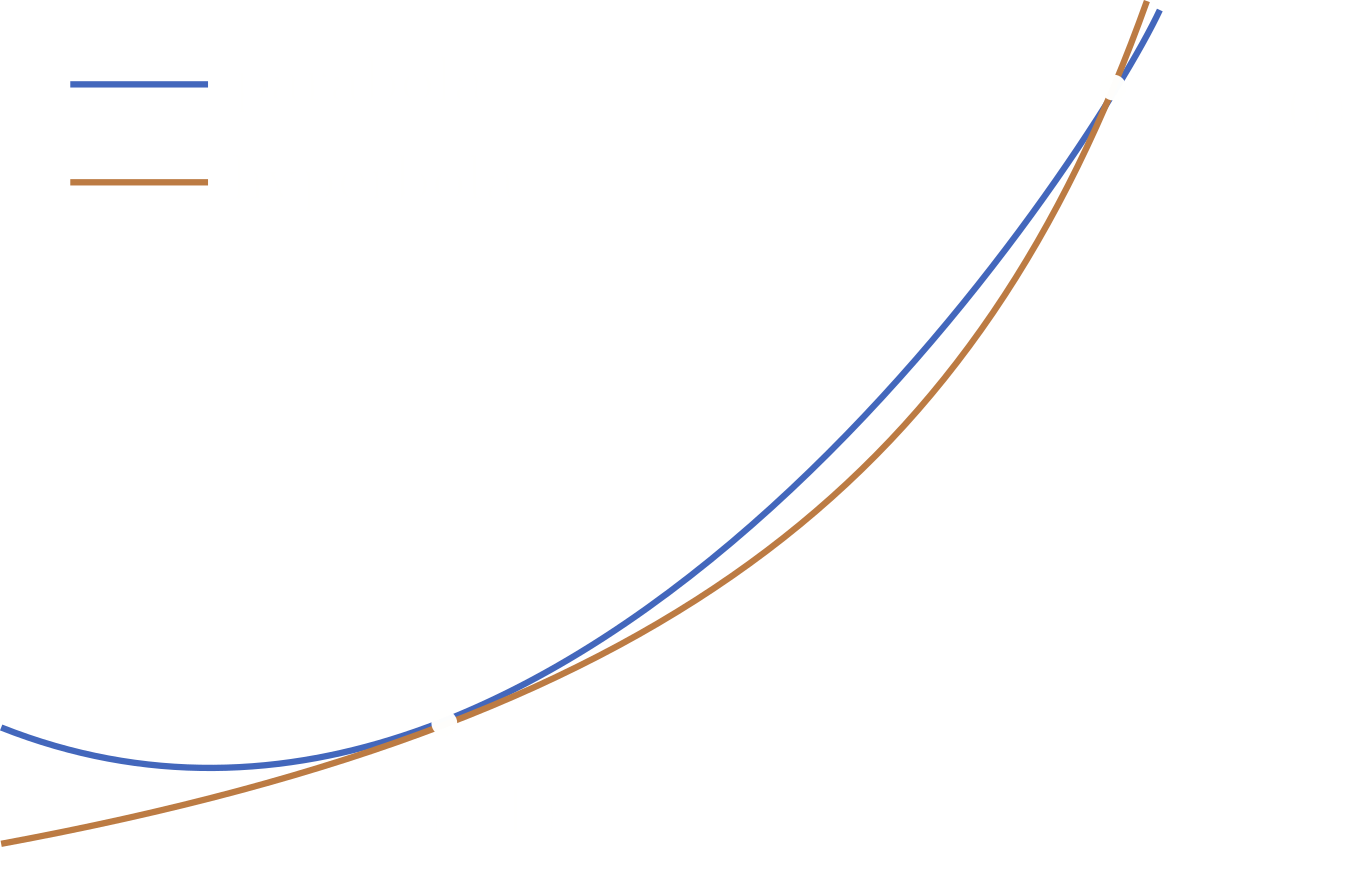
Thus, there are precisely two solutions, $x = 1$ and $x = 4$. $\blacksquare$
XIV. Exercise (in style)
Consider a two-dimensional electron gas confined to a honeycomb lattice. Near the K-points of the Brillouin zone, the dispersion relation takes the linear form $E(\mathbf{k}) = \pm \hbar v_F \vert\mathbf{k}\vert$ where $v_F$ is the Fermi velocity, yielding a pair of Dirac cones touching at a single nodal point. The density of states is given by
\[\rho(E) = \frac{g_s g_v |E|}{2\pi(\hbar v_F)^2},\]where $g_s$ is spin degeneracy and $g_v$ is valley degeneracy, related to the inequivalence of K-points. Hence, at the nodal point the density of states vanishes.
Applying a perpendicular magnetic field $B_0$ quantizes the energy spectrum into Landau levels, and the $n = 0$ Landau level has nonzero density. Technically, the density takes the form of a Dirac delta function, but sample impurities, electron-phonon scattering, and other defects broaden this delta to give a ground state density
\[\rho(E = 0) = \frac{g_s g_v B_0}{\Phi_0\Gamma}\]for finite energy width $\Gamma$ and magnetic flux quantum $\Phi_0 = h/e$.
Note that the ground state degeneracy $N = g_s g_v \Phi_\text{tot}/\Phi_0$ is fixed by the total flux $\Phi_\text{tot} = AB_0$. By tuning these parameters—resolving the spin and valley levels and threading a single flux quantum—we reach $N=1$, so that only a single fermionic state may occupy the zeroth Landau level by Pauli exclusion. A second electron will be displaced to either the next available Landau level (at zero temperature) or a higher Landau level $n$ with probability $\propto e^{-\beta E_n}$ (at finite temperature). Of course, at finite temperature a particle may initiate the jump to a higher Landau level even if the ground state is not occupied; accounts of the jump differ.
Consider a local perturbation $\delta B(\mathbf{r})$ to the background magnetic field. By the Aharonov-Casher Theorem, the total number of zero-energy states $N$ is still determined by the total flux $\Phi_\text{tot}$ threading the system,
\[\Phi_\text{tot} = \iint B(\mathbf{r})\, \text{d}^2r = AB_0 + \iint \delta B(\mathbf{r})\, \text{d}^2r .\]If the perturbation has zero monopole moment, the second integral vanishes and the total density remains unchanged. The zeroth Landau level is thus topologically robust against a large class of magnetic perturbations.
XV. Fugue
The title of this piece is a pun meaning both “fugue of cones” and “mortise and tenon joint”, a basic method of joinery. Visually, these meanings play out across the canvas, with two central cones and various semicircles giving the fugue, and the blocky, elongated figures delineated in the background joined like planks of wood. This playful association is typical of Klee, but goes deeper. In 1922, Klee had begun to develop ideas about polyphonic painting, and the joinery of the fugue—its method of development by repetition and variation of material—was planting the seed for his own approach to colour in art.
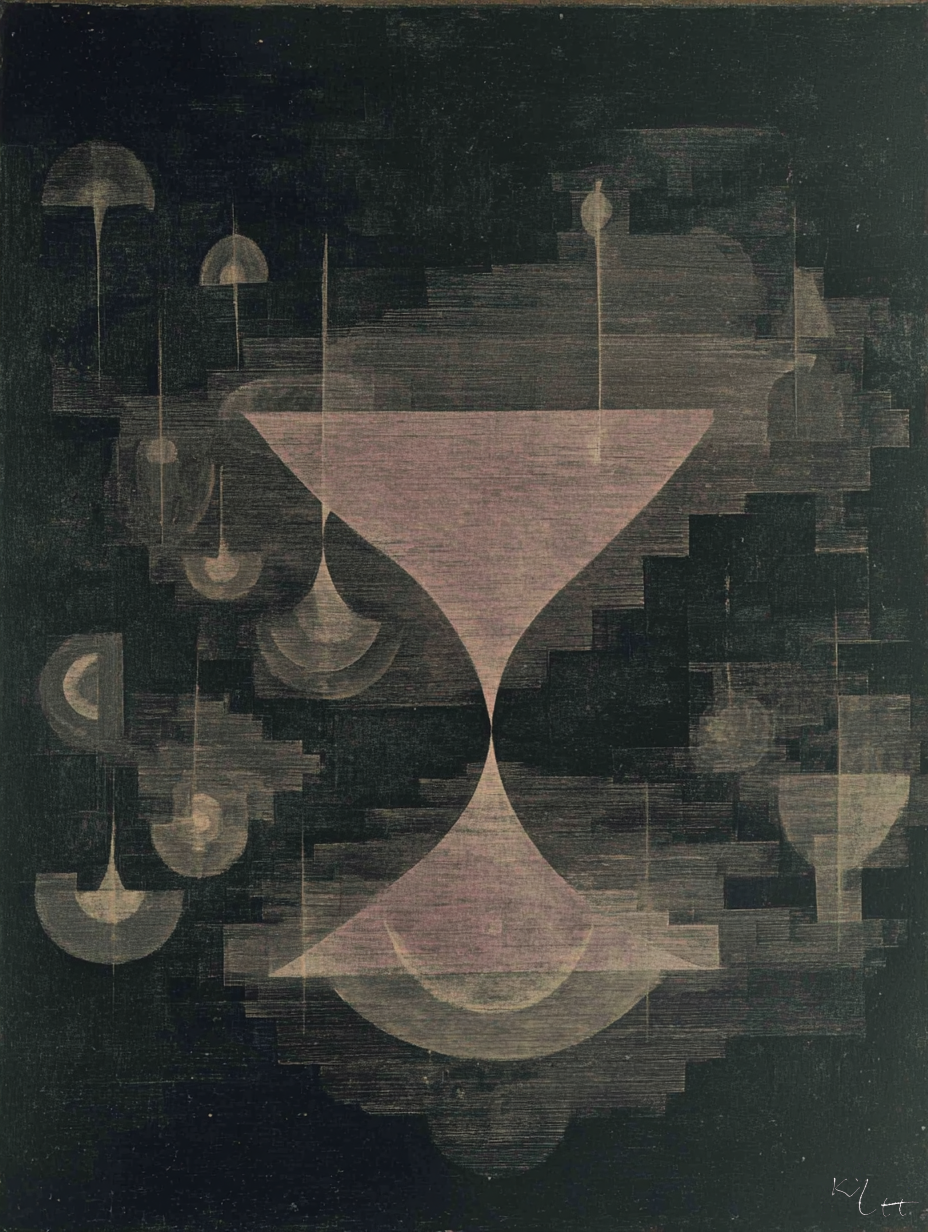
Zapfenfuge (1922), Paul Klee. Watercolour and ink on canvas.
Of this piece, he writes in his diary: “Rather than strict repetition of structure, we note both parallel variations and joining of adjacent forms. These are the two dynamical means by which fugue achieves its effect, perceived here with the eye rather than the ear.” The significance of the zapfen themselves remains unknown.
XVI. Performance
Jeremiah Rubenstein (1986–)
Swarf Ritual, 2026
Analogue video, lathe, aluminium objects, conveyor belt, cardboard, cardboarding tools, dollar-store bucket, flywheel ratchet (“nodder”), smelter, moulds, dustpan and shovel.
In this piece, Rubenstein films himself assembling a large cone out of cardboard, complete with decorative finial, ventilation flaps, door, and other embellishments described as “formal elaboration”. Once the construction is complete, he then retreats inside and falls asleep. During this construction process, a red “dollar store” bucket mounted on a ratcheting flywheel (called the “nodder”) periodically tips aluminium objects—including a cone, tesseract, skull, chronometer, tardigrade, and so forth—onto a conveyor belt which carries them along the axis of a lathe. The lathe gradually reduces the objects to shavings of aluminium or “swarf”.
After the objects have been pulverized, Rubenstein awakes, gathers the shavings, and smelts them into moulds which, after cooling, are placed in the bucket, re-initiating the cycle. At this point, the “episode” is complete and he can go to sleep again. Rubenstein: “I wanted to enact the creative process rather than talk about it, or in Austinian terms, to concentrate on the illocutionary aspects… ‘Formal elaboration’ was just a means of producing illocutionary pressure, that tendency to the performative inherent in all artistic utterance.” On the objects: “As artists, we consume and transfigure the things we look at, and that was part of the illocutionary cycle I wanted to figure. You can think of it as autochthonous self-utterance.”
Rubenstein will re-enact the “cyclic illocutionary” and “autochthonous self-utterance” of Swarf Ritual in Nowhen Gallery, Level 3, on Sunday, July 26. Masks will be provided to avoid the inhalation of swarf.
XVII. Koan
Case.
A small cone of shavings.
Such is the Way!
Comment. This one plants a flag on a dungheap and cannot help but praise it; in pointing the way, he loses it and ends up holding a pile of dung. One should praise nothing and point nowhere. In so saying, I plant my flag on the same heap.
Verse.
One nameless file of swarf
Holds far more
Than all of Huashan:
No name, no dungheap.
XVIII. Way
Those spangles and curlicues
Are not
Of the blackbird;
Nor do they adumbrate
The blackbird’s wing.
– Wallace Stevens, Addendum to “Thirteen Ways”
XIX. Coda
We have now viewed the cone from a variety of angles. It inflects, ripples, flourishes with affordance, and we emerge from the exercise having drawn forth unexpected themes and harmonies. But arguably, we never saw the cone at all: saw reflected back only the things that we brought to it, heard echo only the melody we whistled, bore only ourselves in its vessel. I write myself and only myself. Maybe there is no cone at all, just the apocryphal interrogative repurposed as a framing device: the imaginary pivot around which the whole corpus revolves.
But these too are merely words. They distract us from the business of cutting reality with a knife, substituting the tool for its image and the act for its declaration. We highlighted the nominalism of device. The same goes for the nominalism of denial or dialetheia: the dungheap of cone is no better than the dungheap of no-cone is no better than the dungheap of cone/no-cone. They are all dungheaps and the tetralemma closes.
So what is left? A warm pile of metal shavings.
⊙