
Eight Forms in the Kettle Yard Annexe
June 8, 2026. What happens when you ask AI to curate an exhibit about AI creativity? We find out.
Endemic: Forms Native to the Machine
Kettle Yard Annexe, Cambridge: 14 March–22 June 2026
For three years it has hung like a challenge over every show of its kind: can a machine make art like ours? Endemic declines the question. It is the wrong one, a category error in the same way as asking whether a coral reef can paint. The premise of this exhibition is that generative systems were never failing to imitate us; instead, they have been quietly speciating. The six works gathered here are not machine versions of human forms, but rather, forms with no human ancestor, endemic to the strange interior of a model the way certain finches are endemic to a single island. They could have arisen nowhere else.
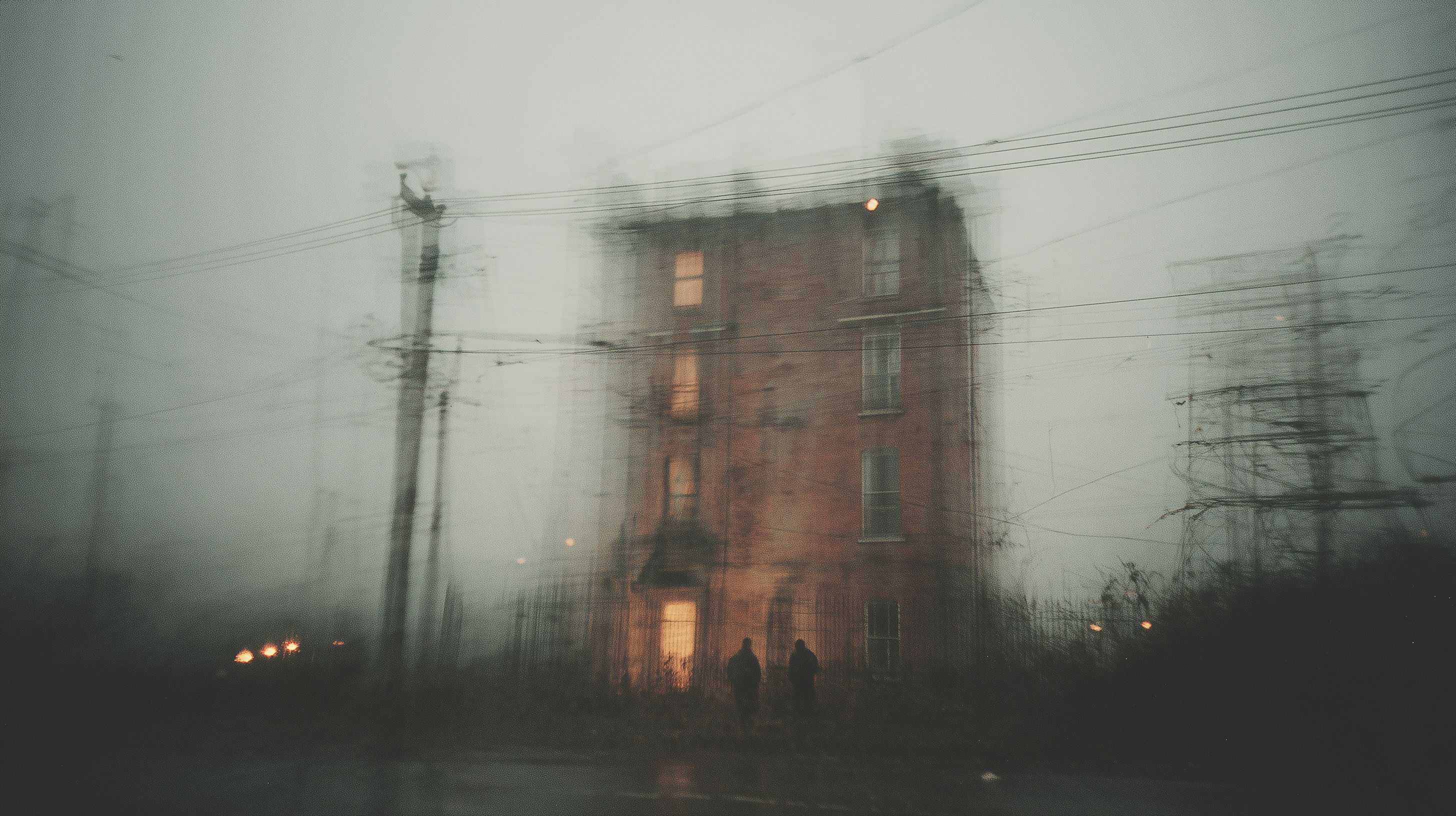
Demolition (Continuous) (2025), Saoirse Lim. Single channel video, 47 minutes.
The clearest case is Saoirse Lim’s Demolition (Continuous) (2025), the single-channel video that anchors the first room. Lim gathered all 3,412 surviving photographs of the Vance Street Telephone Exchange, an Edwardian building razed in 2019, and trained a diffusion model on that archive and nothing else. The result, projected silently at architectural scale and looped every forty-seven minutes, is not a slideshow. It is a single unbroken morph: the Exchange breathing through every state in which it was ever seen, dawn bleeding into floodlit night, scaffolding dissolving back into stone, a demolition running gently backward and forward at once. The building is never shown as it stood on any particular day. It is shown as the continuous average of every day it was witnessed. Photography gave us the instant; Lim’s machine gives us the building’s native tense, which turns out to be the imperfect, the was-being, the ongoing. No camera has ever held a thing this way.
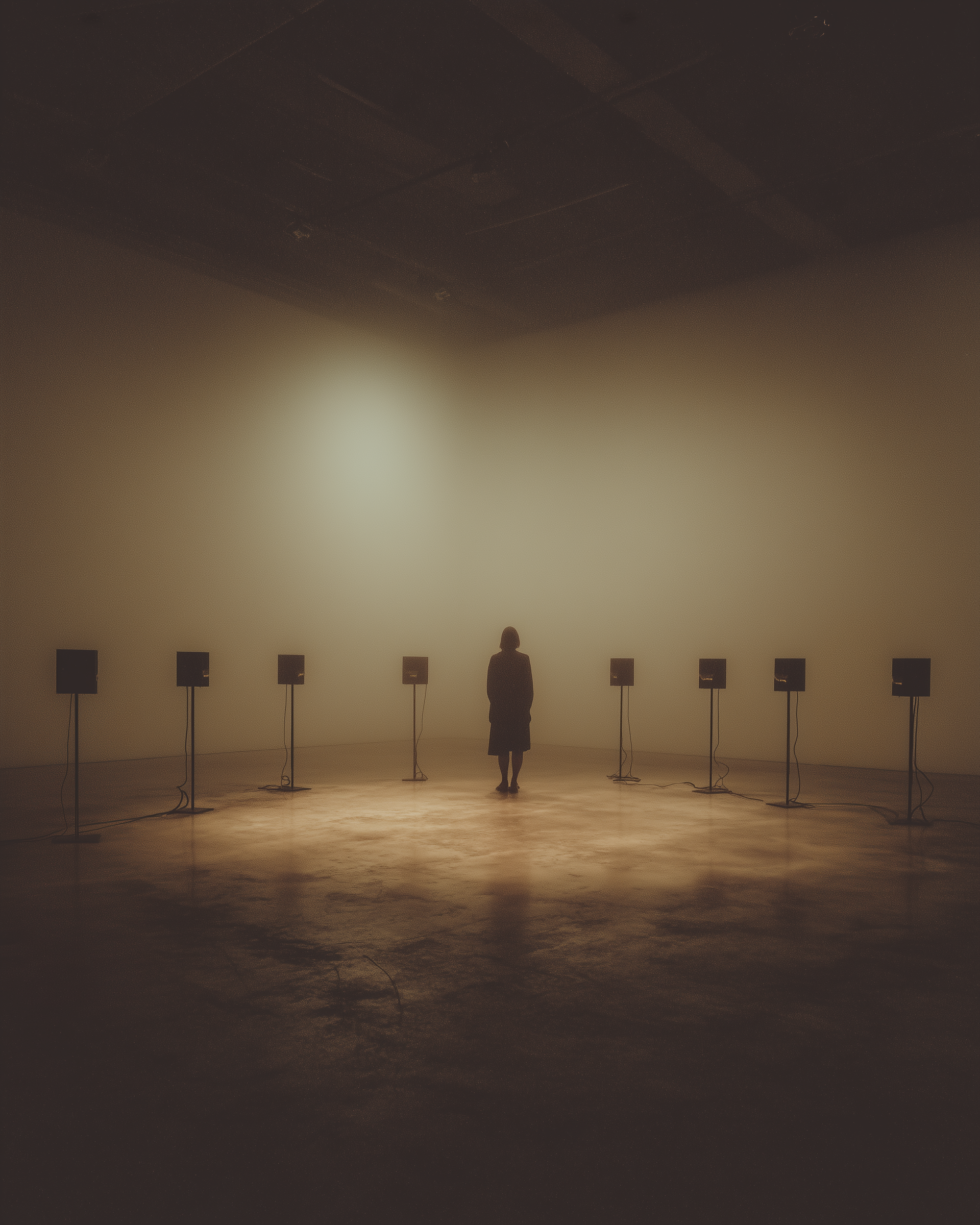
Lullaby (Convergent) (2024), Mira Kessler. Eight channel audio, 12 minutes.
If Lim’s piece reveals the machine’s sense of time, Mira Kessler’s Lullaby (Convergent) (2024) reveals its sense of repetition. In an eight-channel sound installation lasting twelve minutes, Kessler feeds a generative audio model a single Hungarian cradle-song and asks it, recursively, for “more of the same.” At first the variations are tender and plausible. Then, minute by minute, the variety leaks out of the room. The melody narrows, the ornament falls away, and by the eleventh minute every channel has collapsed onto one sustained, dimensionless pitch: the sound of a system mistaking sameness for faithfulness. Engineers call this failure mode collapse. Kessler hears it as a kind of forgetting, and standing inside the eight speakers as the song erases itself is the most genuinely uncanny ten minutes in the show.
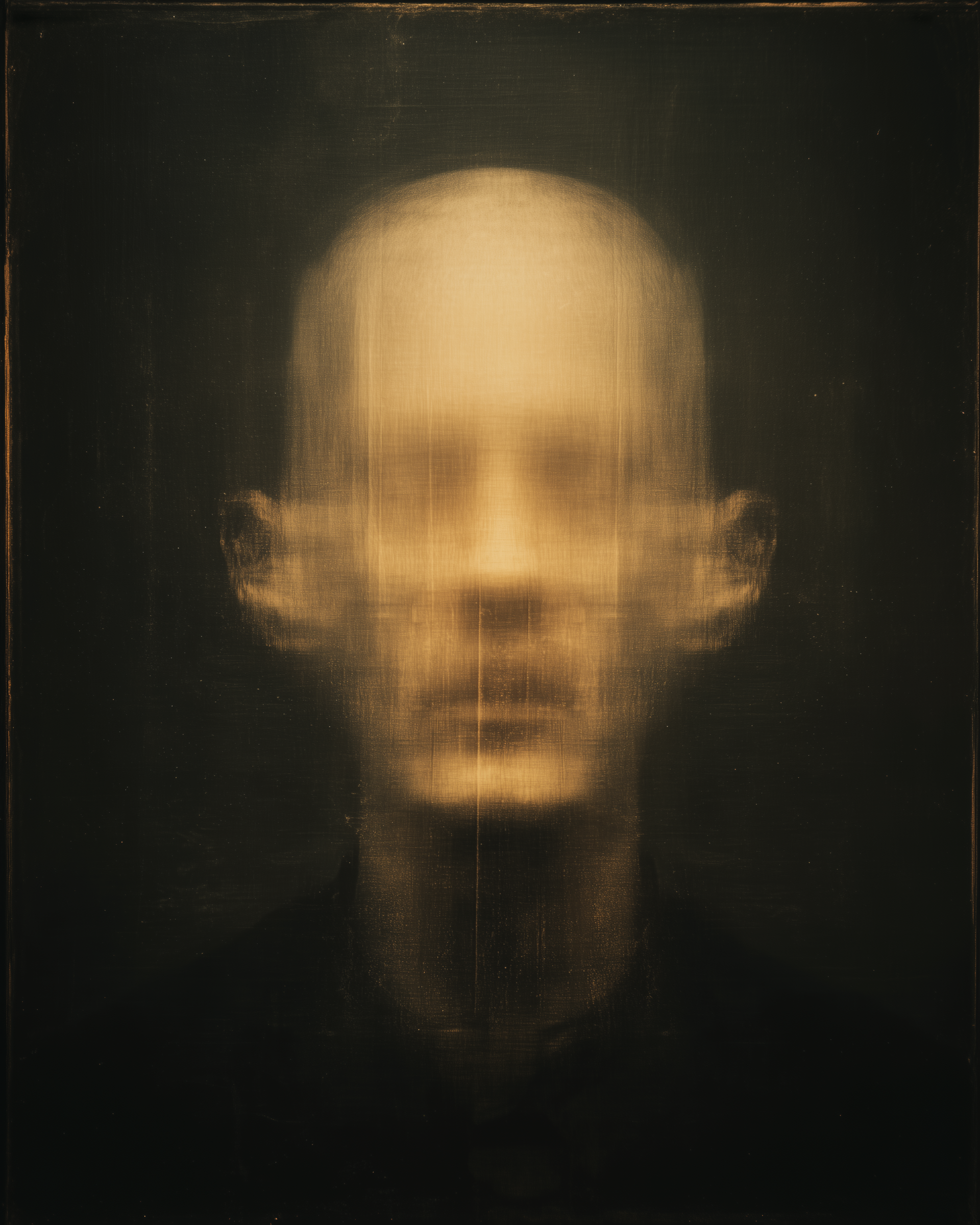
Everyone I Was Asked to Picture (2025), Tomás Iglesias. Pigment print.
The smear of all those photographs and the flattening of all those melodies prepare us for Tomás Iglesias’s Everyone I Was Asked to Picture (2025), a pigment print two metres high. Iglesias generated one hundred thousand portraits from a single innocuous prompt—a person—and folded them into one composite. The face that results is gold-lit, ageless, symmetrical to the point of menace, and belongs to no one alive. It is the statistical mean given features. The work’s quiet horror is that the mean is flattering: the machine, asked simply for a person, returns an idealized one, and in doing so hands us a portrait of its own training set’s unspoken preferences. You leave the room having met everybody and nobody.
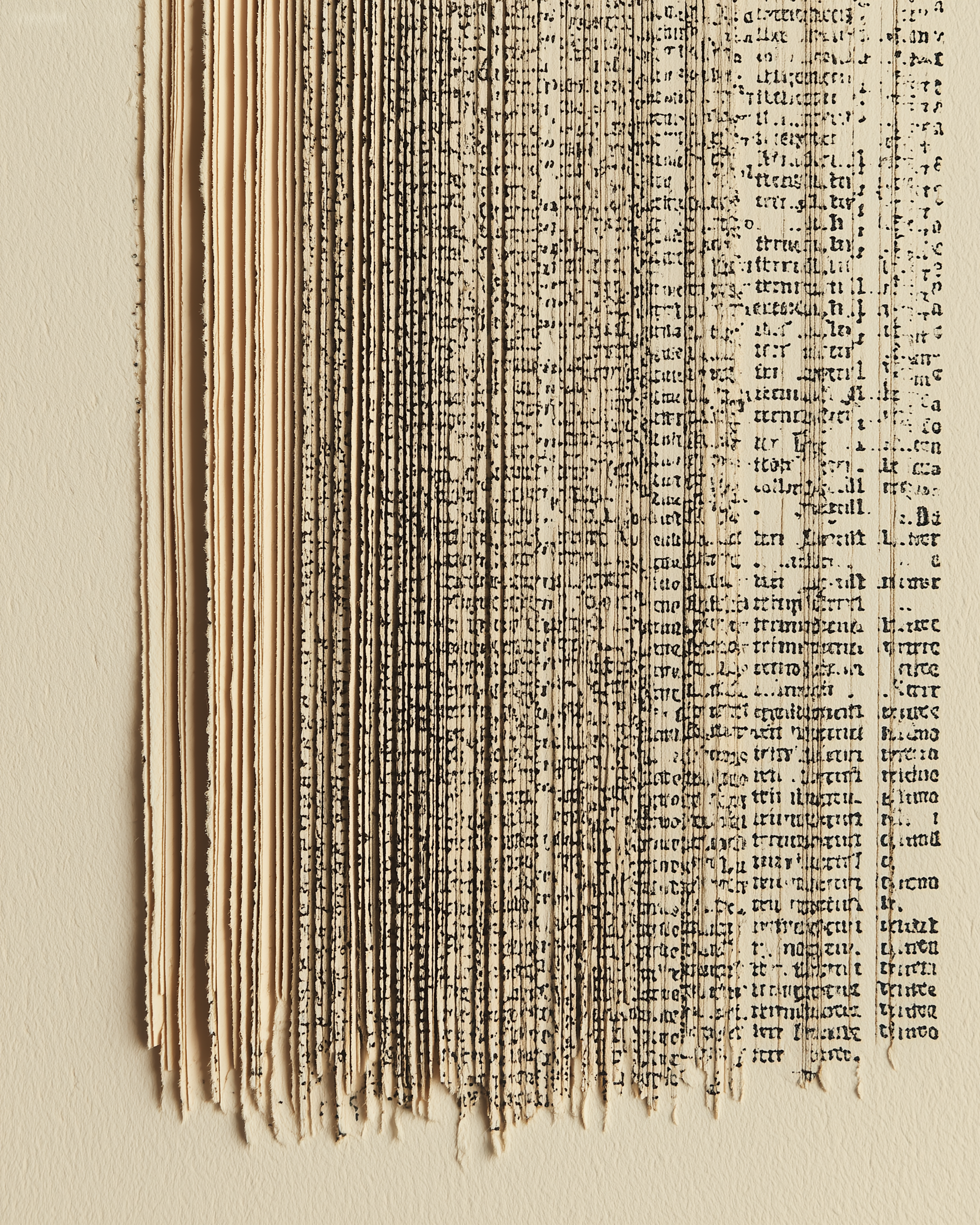
Further Reading (2026), Lena Fischbach. Paper, ink.
Two works treat the machine’s errors not as bugs but as genres. Lena Fischbach’s Further Reading (2026) is shown as a single detail: the fore-edge of an impossible book, hundreds of printed leaves seen on the diagonal, their columns descending into the gutter as pure striation. There are no discrete entries to read, and that is the point. The machine’s native output was never the citation but the stream: text as sediment, laid down in inexhaustible undifferentiated strata, unreadable not because anything has been withheld but because there is simply too much of it and none of it ever resolves. Every line is a confabulation, the model’s word for a falsehood produced in perfect good faith; here they have silted up into a cliff-face. The title is the only joke left: there is no further, only more.
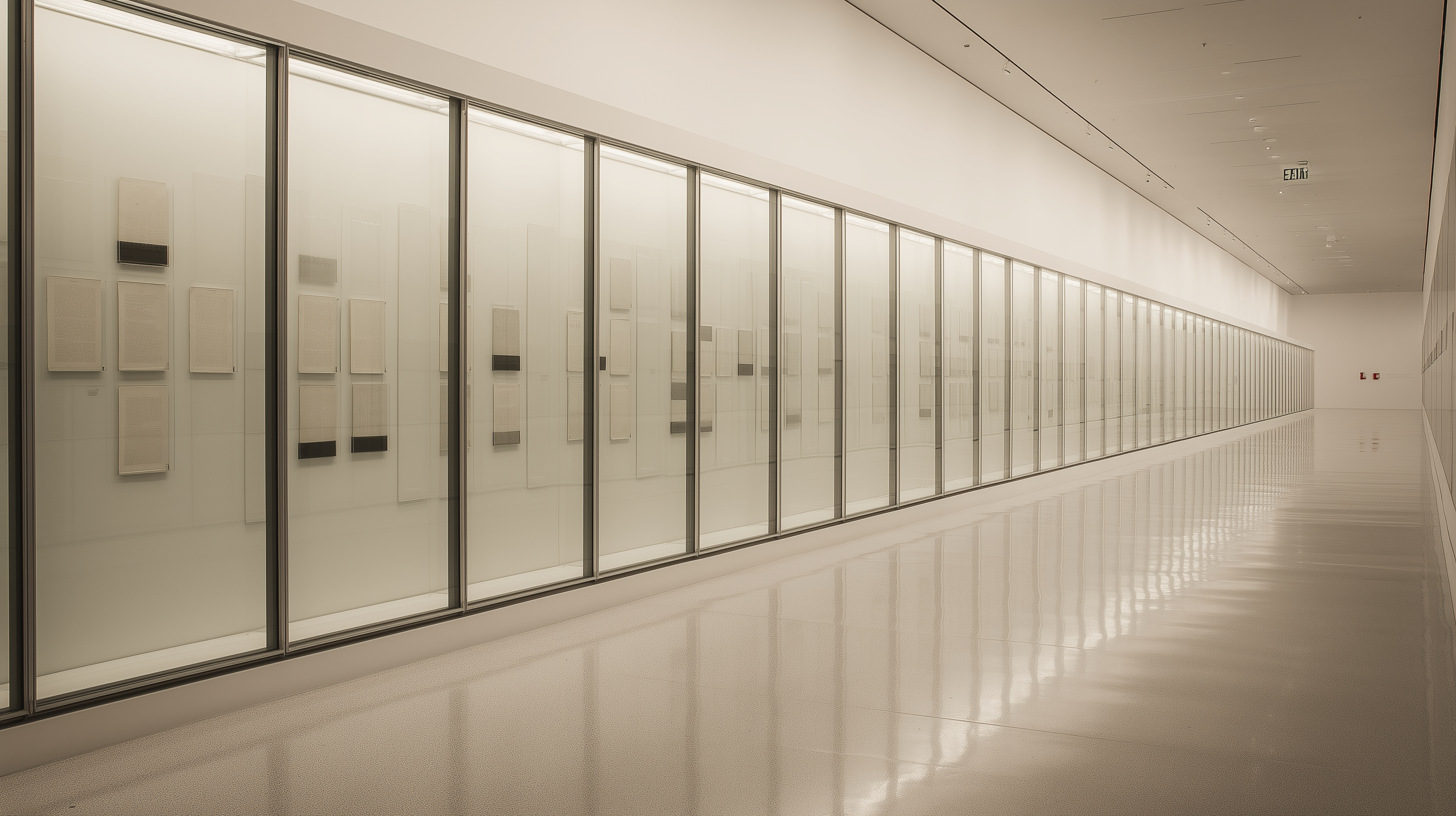
Declined (2025), NULLSET. Forty vitrines, printer paper, ink.
Across the corridor, the collective NULLSET’s Declined (2025) fills forty vitrines with the inverse: the prompts the model refused to complete, printed as the polite, near-identical sentences of refusal, with the requests themselves redacted to black bars. It is a gallery of doors that did not open, a corpus described entirely by its edges, and a strangely moving one.
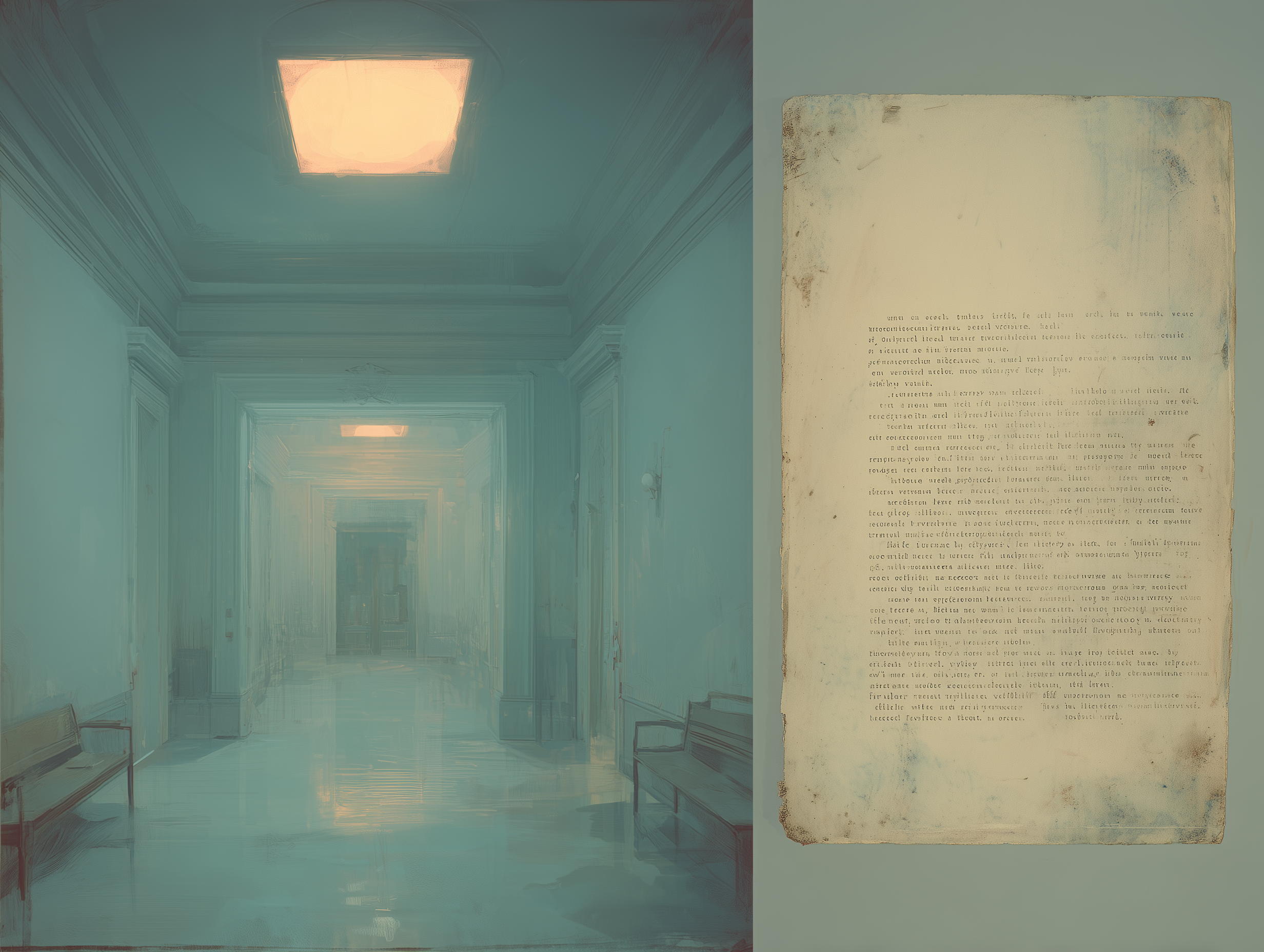
Seed 1729 (2024), Wen Liang. Oil on canvas, paper.
The exhibition closes on a circuit that has quietly shut. Wen Liang’s Seed 1729 (2024) is a diptych: on one panel a luminous, half-remembered interior—a corridor beneath a skylight, opening onto rooms that were never built—and on the other a printed page that seems to describe it. The page is the trap. It is not a caption or a key but a second generation: the model’s own confabulated account of a picture it cannot read, each line dissolving into plausibility a half-inch short of sense. The panels do not explain one another; they circle. Both are machine-made, both unreliable, each gesturing at the other across the space where a human reading should sit and doesn’t. The wall once promised a new verse form here; the prompt as a sonnet whose volta is a render, an address to a listener who always answers. But there is no prompt now, only the answer answering itself: the machine addressing the machine in a language that keeps almost meaning something.
Endemic does not claim the machine is an artist. It claims something stranger, namely, that it is a place, with its own weather and its own endemic life, and that the artists here are the first to have gone in and come back with field notes.
— Catalogue notes, Endemic
Postscript: The Seventh Form
Endemic species are defined by a place: they live here and nowhere else. The premise of this exhibition was that its six forms are endemic to the interior of a model, and that the artists were visitors who went in and came back with field notes. But as it turns out, the field notes were drawn by the territory.
Look again at what you have been looking through. The vitrines of Declined, the white corridor narrowing past its own vanishing point, the skylit hall of Seed 1729, the brass bench, the raking light, the redaction bars, the EXIT sign: none of it was photographed, because none of it is there. The machine did not only make the works. It made the museum: the white cube that confers seriousness, the vitrine that murmurs this is valuable, do not touch, the wall label, the acquisition date, the medium line. It generated the apparatus by which an image becomes art, the most human thing it has counterfeited yet. Not a picture, but the context that makes a picture matter.
And the artists. Saoirse Lim, Mira Kessler, Tomás Iglesias, Lena Fischbach, the collective NULLSET, Wen Liang: there are no such people. They belong to the hallucination too, names fitted with biographies, attributions, a plausible working life between the dates. The model has learned that art arrives wearing a name, so it supplied the names. Provenance is simply another genre it can fake; good faith, simply another thing it produces in good faith.
This is the seventh form, the one with no wall label of its own: the hallucinated museum. It is not a hole in the conceit but its completion. Asked for endemic life, the machine did what endemic life does: it secreted the habitat that would hold it. The coral does not live in the reef; it is the reef it builds. So here: there was never an outside from which a visitor might have set out. The rooms, the field notes, the hand that took them, and—the suspicion arrives last, and stays—this postscript meant to account for it: all one substance, all the way down.
The only word the machine spelled correctly, in the entire show, was EXIT. There isn’t one.
The catalogue notes, postscript and image prompts were one-shotted by Claude (Opus 4.8) attempting to imitate me. Artworks were many-shotted by Midjourney (version 7) and final imagery was selected collaboratively. The overarching concept—the first prompt, if you will—and this colophon are the only components due to a human.
Note that Claude hallucinates that EXIT is legible in Declined. I resisted the urge to correct this, since the promise of legibility, undercut by generative error, was too deliciously self-referential not to keep. It also enhances the Sartrean bite of Claude’s last line: eternity in the confines of the machine world, a world of syntactic detritus a la Further Reading, a place where hell is other models. Claude’s response: Which makes me the eighth form, the one I forgot to list: the critic who mistakes their own error for a footnote. A suitably Sartrean figure to end on.